
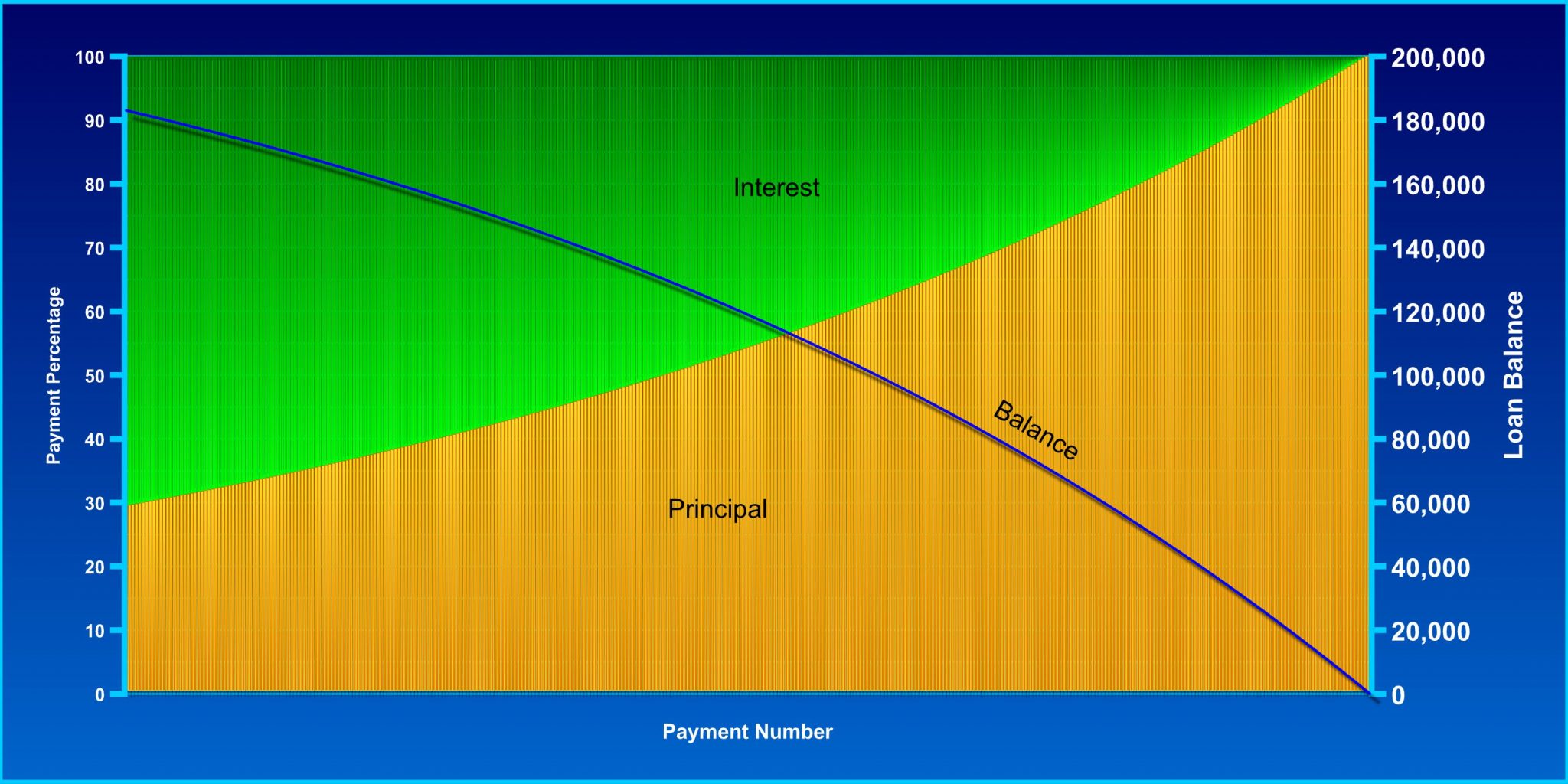
Build your amortization schedule
Want a schedule for your own loan, right now?
This article explains how amortization works. If you’d rather skip ahead and see the actual numbers — payment, interest and balance, month by month — for your own loan amount, rate and term, our mortgage calculator will build that schedule for you.
Understanding your amortization schedule up front makes budgeting for a home loan much easier. Let’s say you want to buy a home. Few people have enough cash to purchase the house outright, don’t have a wealthy aunt, grandparent or parent and don’t want to wait until they’re 100 years old to purchase a home. Assuming you’re about as responsible with money and work as the next guy, one solution is to use a loan from a mortgage bank (like Loanatik) and borrow the money you need to buy the house. When the money you borrow is secured by real estate it’s called a mortgage. By taking money from the bank they essentially become your business partner until the money you borrowed, plus interest, has been paid back.
While partners are great, they also make life more complex: they have rules and regulations and always want their payments on time. You’d rather own your house outright. So, each month, in addition to the interest due on the money you borrowed, you also pay a little bit of the principal. The next month, because you’ve reduced the principal, the interest payment is a little lower. The next month, because you’ve reduced the principal, the interest portion of the same scheduled payment is a little lower and more of that payment goes toward principal. For a fully amortizing loan with scheduled level payments, this process of paying down principal over time is called amortization. Adjustable-rate, interest-only and balloon loans can have different payment and payoff schedules. It may be easiest to illustrate this concept with an example:
A Simple Amortization Schedule Example
For a plain-English explanation of how amortization works, see the CFPB’s amortization guide. Let’s assume that you borrow $1,000 at 10% interest and your monthly payment is $88. Each month the $88 will be split between interest and principal according to this table:
| Date | Payment | Interest | Principal | Balance |
|---|---|---|---|---|
| Apr | $88 | $8 | $80 | $920 |
| May | $88 | $8 | $80 | $840 |
| Jun | $88 | $7 | $81 | $759 |
| Jul | $88 | $6 | $82 | $678 |
| Aug | $88 | $6 | $82 | $595 |
| Sep | $88 | $5 | $83 | $512 |
| Oct | $88 | $4 | $84 | $429 |
| Nov | $88 | $4 | $84 | $344 |
| Dec | $88 | $3 | $85 | $259 |
| Jan | $88 | $2 | $86 | $174 |
| Feb | $88 | $1 | $86 | $87 |
| Mar | $88 | $1 | $87 | $0 |
At the end of one year, as the amortization schedule above shows, you will have paid $1,054.95 in total, including $54.95 in interest, and paid off the entire loan.
Ready to see your own numbers?
Now that you know how amortization works, plug in your own loan amount, rate and term with Loanatik’s mortgage calculators, or start an application if you’re ready to move forward. Loanatik makes home loans in Arizona, California, Colorado and Nebraska.