

In a unanimous vote, the central bank’s Federal Open Market Committee (FOMC) determined that the time was right to move forward with raising the rates. “In view of realized and expected labor market conditions and inflation, the Committee decided to raise the target range for the federal funds rate to one-half to three-quarter percent,” said the FOMC in a statement. “The stance of monetary policy remains accommodative, thereby supporting some further strengthening in labor market conditions and a return to two percent inflation.”
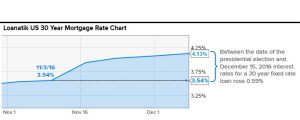 Immediately following the presidential election, in November 2016, mortgage rates began to rise. The day prior to the election rates for a 30 year fixed rate home mortgage were at 3.54%. In the 30 days since the election rates rose 0.81 percentage points to 4.35%, a larger rise than we’ve seen in years. While the increase did not have an immediately adverse impact on residential purchase transactions, it had a devastating effect on refinance transactions. Corey Schwartz, President of Loanatik, said, “We have seen millions of dollars of residential refinance transactions fall out of our pipeline in the weeks following the election”.
 It’s hard to understand the impact of these increases unless you’re looking at a real financing scenario, said Schwartz. The property to the right 5813 E Marconi Ave, Scottsdale, AZ 85254 (MLS#5529851) is listed at $475,000. Assuming the loan amount would be $390,000, prior to the election your principal and interest payment on a 30 year loan would have been $1,759.99. After the election the monthly payment has risen to $1,941.47 an increase of 181.48 dollars per month.
Marco Leone, Vice President of Production at Loanatik said that buyers simply won’t be able to afford as much house as rates continue to rise.
How the Federal Funds Rate Affects Your Mortgage
For the official schedule and statements behind these moves, see the Federal Reserve’s own monetary policy page.
From December 2015 through the May 2, 2018 meeting, the FOMC raised the target range in 0.25-percentage-point increments at seven meetings, from 0.25%–0.50% to 1.50%–1.75%. The federal funds rate does not directly determine long-term mortgage rates, but it can influence short-term borrowing costs, including credit cards and many variable-rate home equity lines of credit. Connected to the federal funds rate is the concept that moderate inflation has been feared from an economy that is beginning to overheat. The stock market has also done very well since the election and investors are moving money out of the bond market and into the stock market because they think that the economy will continue do better in the coming years and that the stock market will be the place for them to make money.
Curious how the federal funds rate affects your own rate?
RATE SEARCH: Get prequalified for a mortgage today.
Want to know what you actually qualify for? Answer a few questions and a licensed loan officer reviews it, with no credit pull to start and an answer usually the same business day. Check my options →